I ) The forms of the simple present
The affirmative form of the simple present:
| I, you, we, they | play. |
| He, she, it | plays. |
Remember the verbs in the third person singular (he,she and it) always take an "s". For example, "he plays, she sings,itworks..."
Examples:
- Nancy and James speak good German.
- Nancy works in a restaurant downtown.
- The children play in the garden every weekend.
The interrogative form of the simple present:
| Do | I, you, we, they | play? |
| Does | he, she, it |
Examples:
- Do you speak good German?
- Does Nancy work in a restaurant downtown?
The negative form of the simple present:
| I, you, we,they | do not | play. |
| don't |
| He, she, it | does not |
| doesn't |
Examples:
- No, I don't speak German.
- No, she doesn't work in a restaurant downtown
II )
The Present Continuous / Progressive
|
John is in his car. He is in his way to work.
He is driving to work
This means he is driving now: “at the time of speaking”
This is the present continuous.
|
The form of the present continuous tense
| The verb to be (in the simple present) | verb + ing |
|---|
The affirmative forms of the present continuous:
I
| am | eating. |
| ’m |
| You, we, they | are |
| ’re |
| He, she, it | is |
| 's |
The interrogative forms of the present continuous
| Am | I | eating? |
| Are | you, we, they |
| Is | he, she, it |
The negative forms of the present continuous
| I | am not | eating. |
| ’m not |
| You, we, they | are not |
| aren't |
| He, she, it | is not |
| isn't |
The use of the present continuous tense

- The present continuous is used to talk about actions happening at the time of speaking.Example:
- Where is Mary? She is having a bath. (Not she has a bath)
- What are you doing at the moment in front of your screen? Don't you know? Well … you are readingthis lesson. You are learning English.
- The present continuous can also be used when an action has started but hasn’t finished yet.
Example:
- I am reading a book; it’s a nice book. (It means = I am not necessarily reading it; I started reading it but I haven’t finished it yet
Special verbs
There are verbs which are normally not used in the present continuous.
Examples:
be, believe, belong, hate, hear, like, love, mean, prefer, remain, realize, see, seem, smell, think, understand, want, wish
It's not correct to say:
He is wanting to buy a new car.*
You must say:
He wants to buy a new car.
III )
The simple past tense of the verb to be:
This page will present the simple past tense of the verb to be:
The affirmative form:
| I, he, she, it | was. |
|---|
| you, we, they | were. |
|---|
Examples:
- I was in London in 1999.
- Pam was in London in 1999, too.
- We were together.
- She was my girlfriend.
The interrogative form:
| Was | I, he, she, it? |
|---|
| Were | you, we, they? |
|---|
Examples:
- Were you in London last year?
- Was Pam with you?
- Were you together?
The negative form:
| I, he, she, it | was not. |
|---|
| wasn't. |
| You, we, they | were not. |
|---|
| weren't. |
Examples:
- I wasn't in Paris in 1999.
- Pam wasn't in Paris in 1999.
- We weren't in Paris.
Use of the simple past
The simple past is used principally to describe events in the past.
Remember:
1. wasn't is the short form of was not. You can say either:
- I was not in Paris, or
- I wasn't in Paris.
2. weren't is the short form of were not. You can say either:
- we were not in Paris, or
- we weren't in Paris.
IV )
The simple past tense
This page will present the simple past tense:
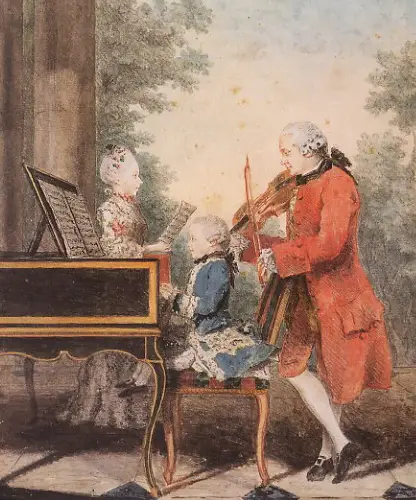
Before you continue the lesson read the following passage and try to see how the verbs are formed and used.
Wolfgang Amadeus Mozart was an Austrian musician and composer. He lived from 1756 to 1791. He started composing at the age of five years old and wrote more than 600 pieces of music. He was only 35 years old when he died.
The verbs "was, lived,started, wrote, died" are in the simple past tense.
Notice that:
- lived, started,died are regular past forms.
- was, wrote are irregular past forms.
|
Regular verbs:
The verbs "lived, started, died" are regular past forms. The rule is the following:
Examples:
| The infinitive | The simple past |
|---|
| live | lived |
| start | started |
| die | died |
| visit | visited |
| play | played |
| watch | watched |
| phone | phoned |
| marry | married |
For the spelling of the -ed forms click here.
Irregular verbs:
The verbs "was, wrote" are irregular past forms. "Was" is the simple past of "to be"; "wrote" is the simple past of "write".
More on the simple past of "to be" here.
There is no rule for these verbs. You should learn them by heart.
| The infinitive | The simple past |
|---|
| be | was/were |
| write | wrote |
| come | came |
| do | did |
| meet | met |
| speak | spoke |
As you can see we can not predict the simple past forms of these verbs. They are irregular. You should learn them by heart.Here is a list of irregular verbs.
The forms of the simple past:
The Affirmative form of the simple past:
| I, you, he, she, it, we, they | played. |
| wrote |
| did. |
Examples:
- I played tennis with my friends yesterday.
- I finished lunch and I did my homework.
The interrogative form of the simple past:
| Did | I, you, he, she, it, we, they | play? |
| write |
| do? |
Examples:
- Did you play basketball yesterday?
- Did you watch television?
- Did you do the homework?
The negative form of the simple past:
| I, you, he, she, it, we, they | did not/didn't | play |
| write |
| do |
- I didn't like the food in the wedding last Saturday.
- I didn't eat it.
The use of the simple past
The simple past is used principally to describe events in the past, but it also has some other uses. Here are the main uses of the simple past.
Finished events in the past
- William Shakespeare wrote Hamlet.
- Christoph Columbus discovered America in 1492.
- He kissed her and left.
Past habitual action
- I visited them every day for a year.
- I drove to work every day when I worked with that company.
Events that were true for some time in the past
- He lived in Paris for 20 years.
- They talked on the phone for ten minutes.
Remember:
didn't is the short form of did not. You can say either:
- I did not play basketball, or
- I didn't play basketball.
___________________________ END _______________________________________

Comentarios
Publicar un comentario